
Category: Event Page
-
Quantum simulation, control and calibration using Qibo
Wednesday 10 May/23 14:00 -15:00 (CEST) Quantum simulation, control and calibration using Qibo This lecture is organised as part of the CERN QTI online lecture series. In this talk, the latest developments of Qibo, a full-stack and open-source framework for quantum computing, will be presented. Qibo was initially born as a quantum circuit simulation tool,
-
Ab-initio two-dimensional digital twin for quantum computer benchmarking
Wednesday 19 Apr/23 11:00 -12:00 (CEST) Ab-initio two-dimensional digital twin for quantum computer benchmarking This lecture is organised as part of the CERN QTI online lecture series. Large-scale numerical simulations of the Hamiltonian dynamics of a Noisy Intermediate Scale Quantum (NISQ) computer – a digital twin – could play a major role in developing efficient
-
Stochastic quantum simulations for scattering experiments
Wednesday 5 Apr/23 14:00 -15:00 (CEST) Stochastic quantum simulations for scattering experiments This lecture is organised as part of the CERN QTI online lecture series. Simulating many-body quantum systems is a promising task for quantum computers. However, early fault-tolerant devices are not expected to correct arbitrary amounts of error, making the quest for better algorithms
-
On the construction of useful quantum kernels
Wednesday 29 Mar/23 14:30 -15:30 (CEST) On the construction of useful quantum kernels This lecture is organised as part of the CERN QTI online lecture series. The representation of data is of paramount importance for machine learning methods. Kernel methods are used to enrich the feature representation, allowing better generalisation. Quantum kernels implement efficiently complex
-
Classical Splitting of Parametrized Quantum Circuits
Wednesday 15 Mar/23 11:00 -12:00 (CET) Classical Splitting of Parametrized Quantum Circuits This lecture is organised as part of the CERN QTI online lecture series. In this talk, we will dive into the topic of barren plateaus and investigate a new method to avoid them. Barren plateaus appear to be a major obstacle for using
-
Noisy gates approach for simulating quantum computers
Wednesday 1 Mar/23 11:00 -12:00 (CET) Noisy gates approach for simulating quantum computers This lecture is organised as part of the CERN QTI online lecture series. In this seminar, the speakers present a novel method for simulating the noisy behavior of quantum computers, which allows to efficiently incorporate environmental effects in the driven evolution implementing
-
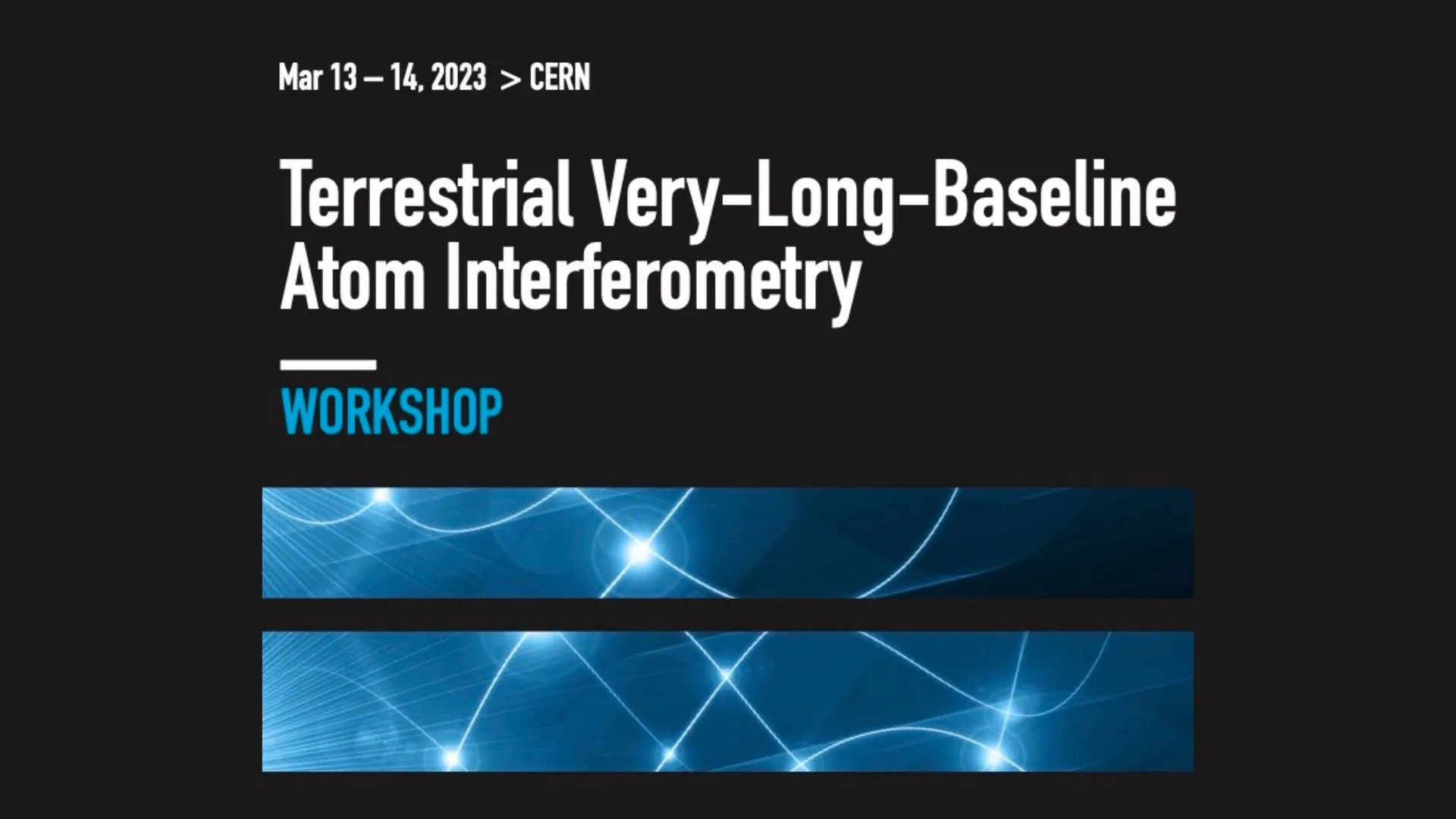
Terrestrial Very-Long-Baseline Atom Interferometry Workshop
Monday 13 Mar/23 8:30 (CET) Ends: 14 Mar/23 18:00 Terrestrial Very-Long-Baseline Atom Interferometry Workshop The experimental landscape of AI projects has expanded significantly in recent years, ranging from ultra-sensitive experimental setups to portable devices and even commercially available gravimeters. Several large-scale terrestrial AIs based on Cold Atom technologies are currently under construction, in planning stages
-
QT4HEP22
Tuesday 1 Nov/22 9:00 (CEST) Ends: 4 Nov/22 17:30 QT4HEP22 Registration is now open for the International Conference on Quantum Technology for High-Energy Physics, which will be hosted at CERN on 1–4 November 2022. Following CERN’s successful workshop on quantum computing in 2018, this is the first edition of the QT4HEP conference taking place to
-
CERN UK Quantum Technology Roadshow
Monday 11 Jul/22 8:55 (GMT+1) Ends: 14 Jul/22 18:20 CERN UK Quantum Technology Roadshow Collaborate with CERN to solve your problems in quantum technology Quantum technologies are set to revolutionise our world by applying the seemingly mysterious laws of physics at the smallest scales to real-world applications like computing, communications, sensing and imaging. Many of
-
Quantum Sensors for Direct Detection of Sub-GeV Dark Matter
Wednesday 8 Jun/22 16:00 -17:00 (CEST) Quantum Sensors for Direct Detection of Sub-GeV Dark Matter Over the last 20 years, searches for dark matter above the proton mass have advanced significantly across direct and indirect searches, but sub-GeV dark matter has until recently been comparatively unprobed. In this talk, Noah Kurinsky of SLAC National Accelerator