
Hybrid Quantum Computing Infrastructures, Algorithms and Applications
The initial wide adoption of quantum computing will occur through its integration with large-scale classical systems. Rather than operating in isolation, quantum processors will function as specialised accelerators embedded within broader hybrid workflows. This paradigm is already reflected in industrial initiatives for hybrid orchestration, and in the widespread use of hybrid algorithms, with variational quantum algorithms being a notable example.
In parallel, Europe is investing heavily in the integration of quantum computing and classical high-performance computing (HPC), through initiatives such as EuroHPC and EuroQCS. In this evolving landscape, CERN has a unique opportunity — and responsibility — to play a leading and coordinating role, ensuring that the requirements of the High Energy Physics (HEP) community are fully taken into account while providing compelling scientific use cases for the co-development of infrastructures and algorithms.
CERN has historically been at the heart of global distributed computing for science, most notably through the Worldwide LHC Computing Grid. Continuing this leadership today means pursuing the development of exascale, heterogeneous computing infrastructures, integrating classical HPC systems with non–Von Neumann architectures, including GPUs, dedicated AI accelerators, tensor-streaming technologies, and quantum computers.
Scope of the centre of competence
This competence center promotes a comprehensive, end-to-end approach to hybrid distributed computing. Its activities span:
- The development of classical-quantum algorithms for high energy physics applications
- The design and orchestration of hybrid quantum-classical infrastructures
These activities are carried out in close collaboration with industry, academia, and national research centres.
The activities of CoC1 are supported by a body of research at the intersection of quantum computing, quantum algorithms, and high-energy physics, including contributions on:
- Quantum algorithms for lattice field theory and gauge theories
- Variational quantum algorithms and expressivity analysis
- Quantum machine learning models for physics-inspired applications
- Hybrid quantum–classical strategies for near-term devices
Physics simulation
Quantum Field Theories (QFTs) are intrinsically affected by divergences. To connect theoretical predictions with experimental measurements, these infinities must be handled through regularisation and renormalisation. The only known generic non-perturbative approach is lattice field theory, where space-time is discretized and the resulting dynamics are simulated on powerful supercomputers.
Lattice simulations currently provide the only ab-initio method for extracting low-energy properties of quantum chromodynamics (QCD) and nuclear physics with controlled uncertainties. They have enabled successful predictions of light hadron masses, selected scattering parameters, and the spectra of several light hadrons. However, classical Monte Carlo importance sampling suffers from severe limitations, preventing access to key physics questions such as the QCD phase diagram at high baryon density, real-time dynamics of quark–gluon plasmas, and the properties of heavy nuclei and excited hadron states.
As these systems are intrinsically quantum, CoC1 pursues the development of quantum algorithms for lattice simulations, aiming to overcome classical bottlenecks. Progress in this direction would also benefit high-energy QCD phenomenology, including parton shower modeling in LHC collisions, where classical simulations are similarly limited by sampling-based approaches.
Another major research direction concerns neutrino oscillations, particularly in extreme astrophysical environments such as supernova cores. In these regimes, neutrino densities are so high that neutrinos interact with one another, leading to highly non-linear flavour evolution. Classical simulations struggle to capture this collective quantum behaviour, motivating the development of quantum simulation methods for collective neutrino oscillations.
Core activities

The Team

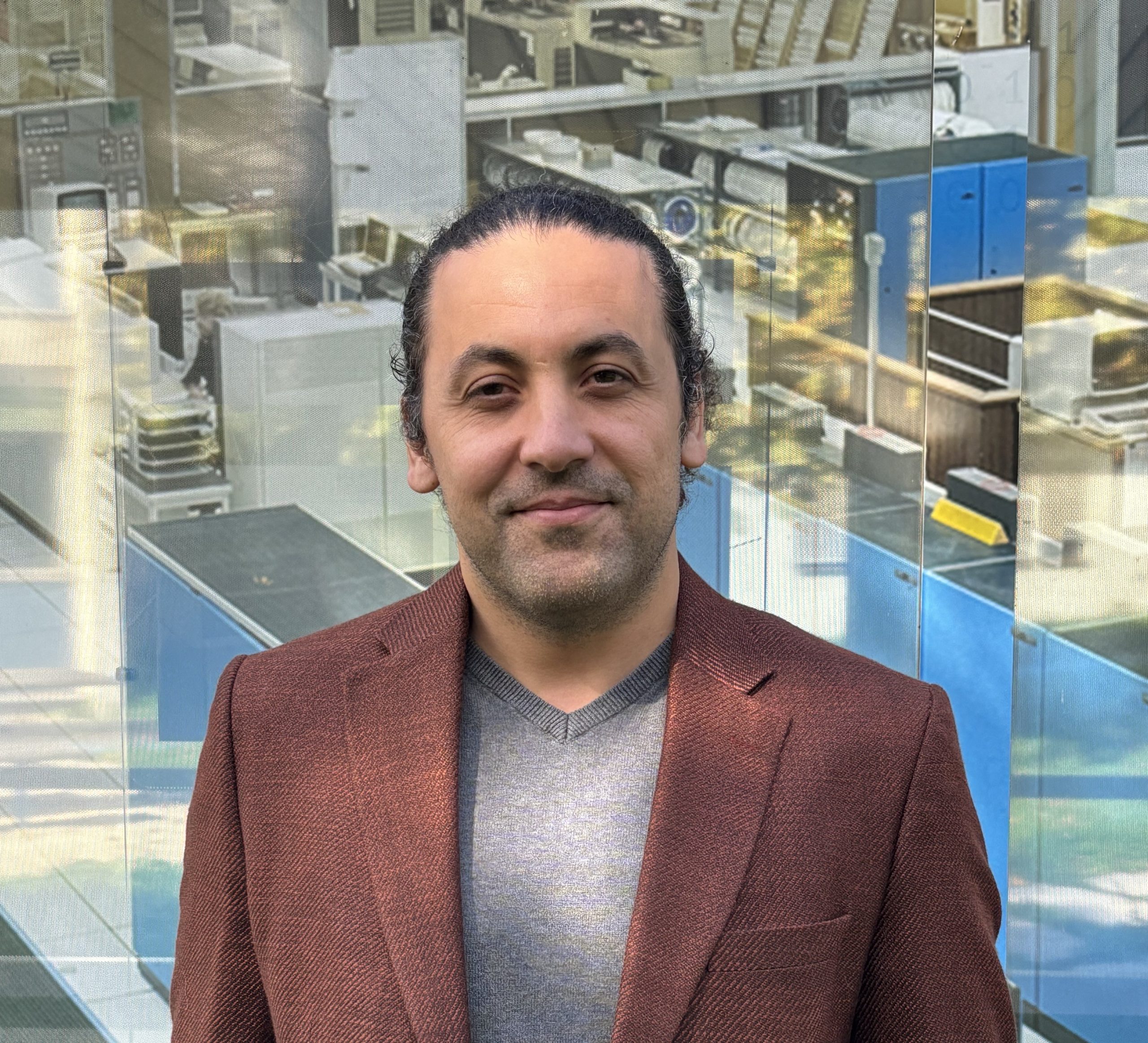
Michele Grossi, Coordinator



Recent publications
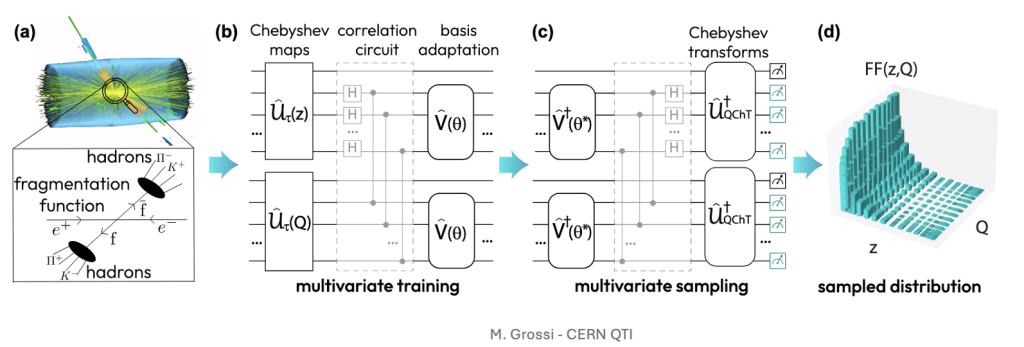
Quantum Chebyshev probabilistic models for fragmentations functions
Quantum generative modeling is emerging as a powerful tool for advancing data analysis in high-energy physics, where complex multivariate distributions are common. However, efficiently learning and sampling these distributions remains challenging. We propose a quantum protocol for a bivariate probabilistic model based on shifted Chebyshev polynomials, trained as a circuit-based representation of two correlated variables, with sampling performed via quantum Chebyshev transforms. As a key application, we study fragmentation functions (FFs) of charged pions and kaons from single-inclusive hadron production in electron-positron annihilation. Our results highlight the growing potential of quantum generative modeling to advance data analysis and scientific discovery in high-energy physics.
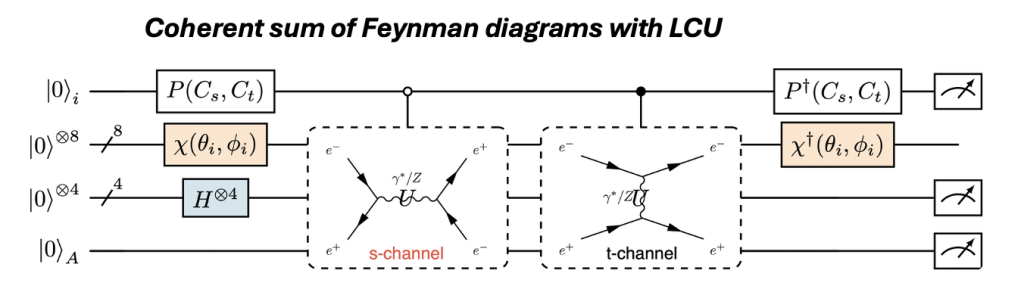
Coherent Evaluation of Collider Amplitudes for Effective Field Theory Constraints
Precision measurements at electron–positron colliders provide stringent tests of the Standard Model and powerful probes of possible higher-dimensional interactions. We present a hybrid quantum–classical framework for computing leading-order helicity amplitudes for e+e−→ℓ+ℓ− scattering on gate-based quantum hardware and using the resulting cross sections to constrain both Standard Model couplings and effective field theory operators. In our approach, external kinematics are encoded into single-qubit Weyl spinors, and full helicity amplitudes are reconstructed by coherently combining diagrammatic contributions within a single quantum circuit. Classical post-processing yields physical amplitudes and differential cross sections that can be directly compared with collider data. The extracted bounds are statistically consistent with Standard Model expectations, demonstrating that quantum-assisted amplitude evaluation can interface directly with phenomenological analyses and experimental data.
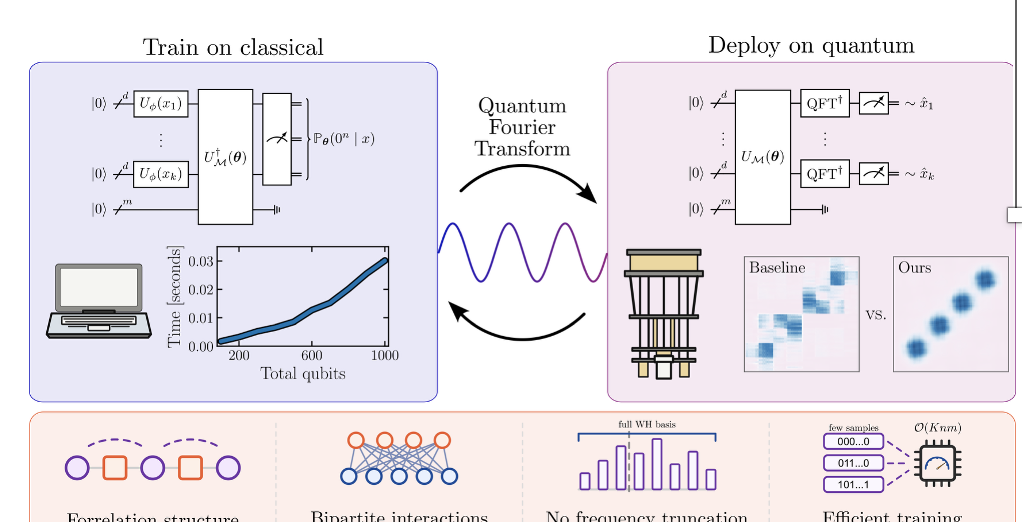
Quantum Fourier Generative Models Trainable at Large Scale
We propose an algorithmic framework for building and training quantum generative models corresponding to multivariate probability distributions. Crucially, we develop a distinct training strategy where training is enabled at large scale by log-likelihood loss with unbiased Monte Carlo estimator based on Parseval’s identity. Once the model is trained, we use inverse quantum Fourier transforms to map it into a separate sampling circuit in the computational basis. We demonstrate the efficiency of the suggested framework by validating loss estimation at the scale of over 1000 qubits on a single GPU. Comparing to classical baselines represented by normalizing flow and diffusion models, we show that our approach avoids oversmoothing and preserves multi-modal structure of the target. Finally, we have deployed the trained models on superconducting quantum devices, successfully sampling distributions with per-sample execution times of approximately 300us. Our train-on-classical deploy-on-quantum work can provide both high-quality structure at increased scale and fast sampling access needed for inference.
Collaborations and Partners