CoC2: CERN Technologies as Quantum Platforms demonstrators
There is growing attention within the scientific community towards quantum sensing and metrology and their potential to enable disruptive advances in particle physics, detector technologies, dark matter searches, antimatter studies, and precision measurements. Within the CERN Quantum Technology Initiative (QTI), activities in quantum sensing focus on exploiting CERN’s unique expertise to explore and benchmark emerging quantum technologies for high-energy physics applications. QTI’s activities currently concentrate on three complementary areas: characterisation of novel cryogenic sensors for future detectors, quantum-enhanced radio-frequency techniques for axion detection, and Rydberg atoms as quantum platforms within the antimatter programme. Quantum technologies are opening new opportunities for high-energy physics by enabling measurements beyond the reach of conventional instrumentation. Superconducting and quantum-enabled devices are already redefining possibilities in timing, position, and energy resolution, while also providing new pathways for dark matter searches and precision measurements.
A collaborative framework for the scientific community
QTI provides a framework through which members of the high-energy physics community, research institutes, universities, and industry partners can engage with CERN on quantum technologies and develop common scientific and technological goals. By combining CERN’s expertise and large-scale research infrastructures with external academic and industrial partnerships, QTI enables collaborative R&D efforts at the interface of quantum science and particle physics. Many activities are developed in close connection with broader international and European initiatives. For example, the QUEST quantum sensor test facility is being developed as CERN’s contribution to the DRD5 detector R&D collaboration, providing infrastructure for the characterisation of cryogenic and quantum-enabled sensors in realistic beam and radiation environments. QTI also aims to facilitate collaboration between experimental physicists, theorists, detector experts, materials scientists, and quantum technology researchers, helping to build a common ecosystem for future quantum applications in high-energy physics.
Current activities


Future directions
One of QTI’s long-term objectives is to pave the way towards future axion experiments based on heterodyne quantum detection techniques.
The QTI Axion Detector Demonstrator (QTI ADD) explores multimode RF cavity concepts combined with cryogenic and quantum-limited readout technologies for the detection of ultra-weak axion-induced signals.
These activities aim to: develop scalable low-noise RF architectures, improve sensitivity to weak microwave signals, and integrate quantum-limited sensing technologies into future dark matter experiments.
Dedicated cryogenic infrastructure and sub-Kelvin operations are currently being deployed at CERN to support these developments.
QTI is developing QUEST, a dedicated Quantum Sensor Test Facility in CERN’s North Area test beams, designed to characterize next-generation quantum sensors under realistic experimental conditions.
QUEST is being developed within the QTI framework as CERN’s contribution to the DRD5 detector R&D collaboration and as a shared infrastructure for the broader scientific and quantum-technology communities. The facility will combine: high-resolution beam instrumentation, cryogenic infrastructure operating down to approximately 1 K, and integration with CERN radiation-test facilities. This unique environment will enable the qualification of quantum sensors in conditions that combine: particle-beam exposure, radiation environments, precision timing measurements, and low-temperature operation.
The first target technologies include superconducting and cryogenic detector systems such as SNSPDs and related quantum sensors for applications in: collider instrumentation, dark matter and axion experiments, precision timing detectors, and quantum communication technologies.
By combining CERN’s expertise in accelerators, cryogenics, detector instrumentation, and radiation testing, QUEST aims to establish a unique European platform for quantum sensor qualification and detector innovation.
QTI aims to strengthen collaborations between high-energy physics, condensed matter physics, materials science, quantum engineering, and industry. A central objective is to create stronger links between detector experts, theorists, and materials scientists to explore how emerging quantum technologies can address future challenges in particle physics.
Planned activities include: surveying emerging technologies such as superconducting detectors, quantum dots, and novel quantum materials, identifying applications in collider physics, dark matter searches, axion detection, and gravitational-wave experiments, and coordinating a community white paper covering both technology opportunities and future experimental directions.
QTI also aims to foster collaborations with European industry and research institutions to support the development and characterisation of strategic quantum technologies within Europe. These activities position CERN as a hub connecting quantum technologies, detector innovation, and fundamental physics research.
The Team
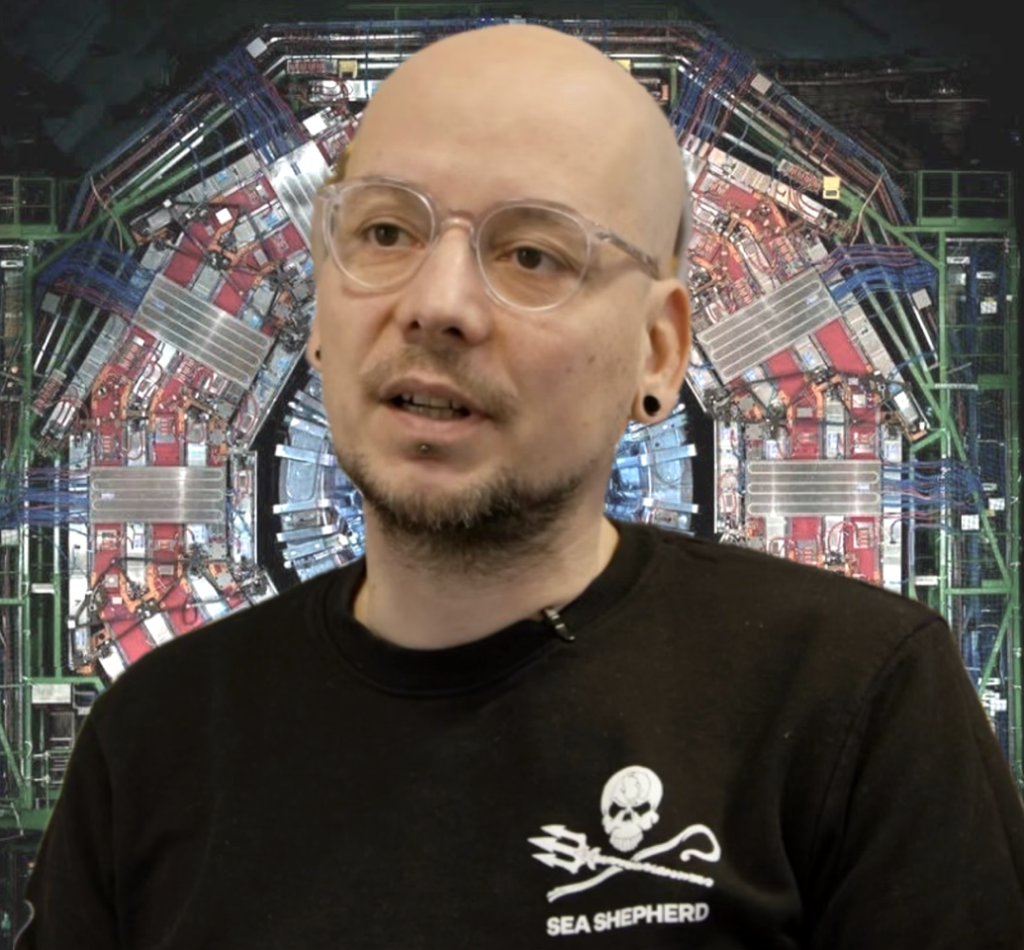



Maurizio Pierini, Quantum Sensing Lead



Sergio Calatroni, CERN Technology Department representative


Marco Volponi, AEgIS

Amanda Díez Fernández, Partnerships
QTI Partners