
Tag: Education
-
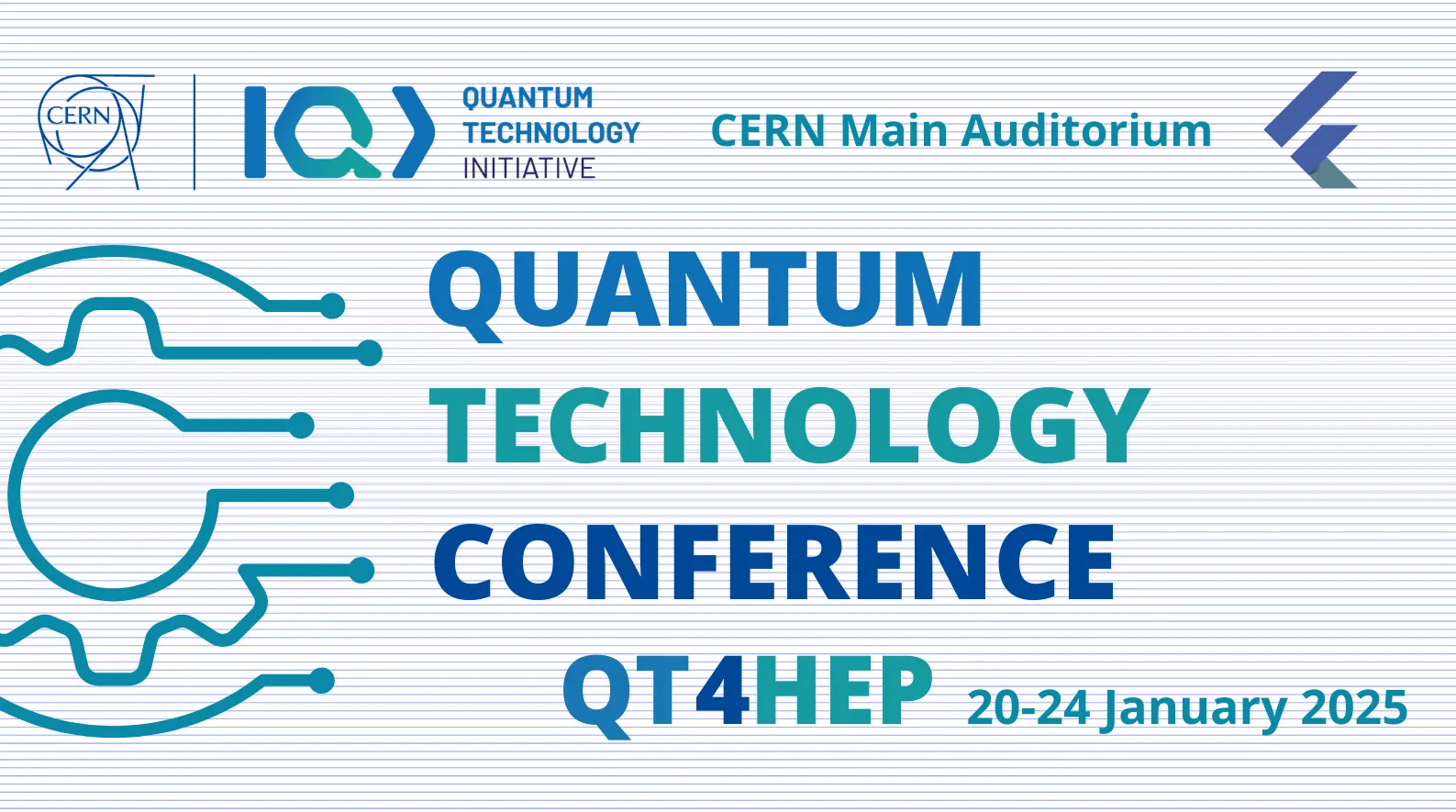
Quantum Technology for High Energy Physics Conference
Monday 20 Jan/25 9:30 (CET) Ends: 24 Jan/25 16:30 Quantum Technology for High Energy Physics Conference The International Conference on Quantum Technology for High-Energy Physics will be hosted at CERN on 20-24 January 2025. Following the great success of QT4HEP 2022, surrounded by the magnificent new architecture of the Science Gateway, this second edition of
-
Operational launch of the Open Quantum Institute
Tuesday 5 Mar/24 12:45 -20:00 (CET) Operational launch of the Open Quantum Institute Join us for the operational launch event of the Open Quantum Institute (OQI) – a new, three-year CERN-based programme that will help to unleash the full power of quantum computing for the benefit of all. Hosted at CERN, born at GESDA, supported
-
Quantum steampunk: Quantum information meets thermodynamics
Friday 17 Nov/23 13:00 -14:00 (CET) Quantum steampunk: Quantum information meets thermodynamics On 17 November, join us for the special edition of the CERN QTI lecture series featuring Dr Nicole Yunger Halpern, theoretical physicist at the National Institute of Standards and Technology (NIST), fellow of the Joint Center for Quantum Information and Computer Science, and
-
Direct detection of light dark matter with superconducting thermometers
Wednesday 7 Jun/23 11:00 -12:00 (CEST) Direct detection of light dark matter with superconducting thermometers This lecture is organised as part of the CERN QTI online lecture series. In the past decades, numerous experiments have emerged to unveil the nature of dark matter (DM), one of the most discussed open questions in modern particle physics.
-
IBM Quantum Platforms: A Quantum Battery Perspective
Wednesday 17 May/23 9:00 -10:00 (CEST) IBM Quantum Platforms: A Quantum Battery Perspective This lecture is organised as part of the CERN QTI online lecture series. In the last few years, the progressive miniaturisation of devices has approached the size of atoms and molecules. The study of these quantum systems out of equilibrium contributed to
-
Quantum simulation, control and calibration using Qibo
Wednesday 10 May/23 14:00 -15:00 (CEST) Quantum simulation, control and calibration using Qibo This lecture is organised as part of the CERN QTI online lecture series. In this talk, the latest developments of Qibo, a full-stack and open-source framework for quantum computing, will be presented. Qibo was initially born as a quantum circuit simulation tool,
-
Ab-initio two-dimensional digital twin for quantum computer benchmarking
Wednesday 19 Apr/23 11:00 -12:00 (CEST) Ab-initio two-dimensional digital twin for quantum computer benchmarking This lecture is organised as part of the CERN QTI online lecture series. Large-scale numerical simulations of the Hamiltonian dynamics of a Noisy Intermediate Scale Quantum (NISQ) computer – a digital twin – could play a major role in developing efficient
-
Stochastic quantum simulations for scattering experiments
Wednesday 5 Apr/23 14:00 -15:00 (CEST) Stochastic quantum simulations for scattering experiments This lecture is organised as part of the CERN QTI online lecture series. Simulating many-body quantum systems is a promising task for quantum computers. However, early fault-tolerant devices are not expected to correct arbitrary amounts of error, making the quest for better algorithms
-
On the construction of useful quantum kernels
Wednesday 29 Mar/23 14:30 -15:30 (CEST) On the construction of useful quantum kernels This lecture is organised as part of the CERN QTI online lecture series. The representation of data is of paramount importance for machine learning methods. Kernel methods are used to enrich the feature representation, allowing better generalisation. Quantum kernels implement efficiently complex
-
Classical Splitting of Parametrized Quantum Circuits
Wednesday 15 Mar/23 11:00 -12:00 (CET) Classical Splitting of Parametrized Quantum Circuits This lecture is organised as part of the CERN QTI online lecture series. In this talk, we will dive into the topic of barren plateaus and investigate a new method to avoid them. Barren plateaus appear to be a major obstacle for using